Every Catholic is obligated to obey the Magisterium, that is, the bishops united under the pope who succeed the Apostles in teaching authority. Focusing on the pope, the Second Vatican Council wrote, “religious submission of mind and will must be shown in a special way to the authentic magisterium of the Roman Pontiff, even when he is not speaking ex cathedra.”1 Thus, Catholics are not free to reject the constant teachings of the popes. Therefore, Catholics must follow the popes of the past centuries in condemning the separation between the Catholic Church
and the state and promote the union of politics and faith.
Since the days of Emperors Constantine I and Theodosius I in the fourth century, the bishops of the Catholic Church under the pope applauded the unity of Church and State. For millennia the popes and bishops taught that the earthly power should be united and subject to the spiritual power. For much of the West’s history, the two worked together and sometimes entered into conflict. This conflict was at its fiercest when in the eighteenth through twentieth centuries, the nations of the West began to reject the union of Church and State. Thus, the popes clearly spoke out against them and affirmed the Church’s teaching.
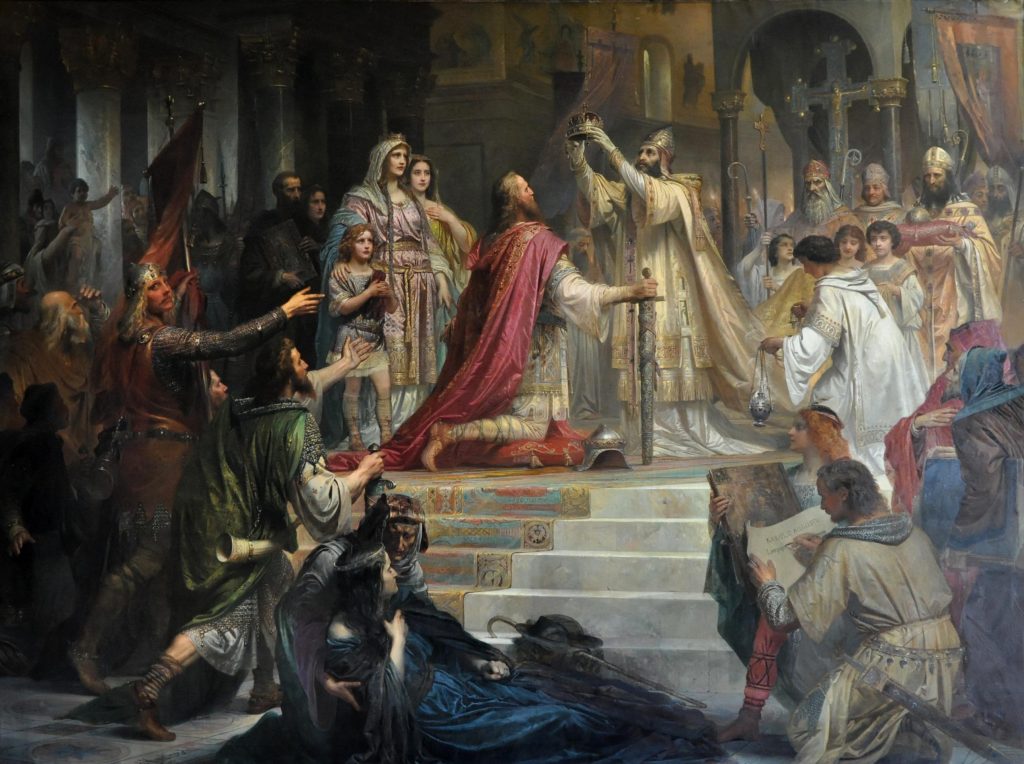
Pope Gregory XVI, (r. 1831–1846) predicted that the separation of Church and state would lead to disaster, he wrote, “[n]or can We predict happier times for religion and government from the plans of those who desire vehemently to separate the Church from the state, and to break the mutual concord between temporal authority and the priesthood. It is certain that concord which always was favorable and beneficial for the sacred and the civil order is feared by the shameless lovers of liberty.”2 Later, Blessed Pope Pius IX (r. 1846–1878) would condemn the idea that, “[t]he Church ought to be separated from the State, and the State from the Church.”3 Pope Leo XIII (r. 1878–1903), taught the same in many places. In his famous work on Liberty, he says,
[t]he profession of one religion is necessary in the State, that religion must be professed which alone is true, and which can be recognized without difficulty, especially in Catholic States, because the marks of truth are, as it were, engraven upon it. This religion, therefore, the rulers of the State, must preserve and protect it, if they would provide as they should do with prudence and usefulness for the good of the community.4
Pope St. Pius X (r. 1903–1914) would condemn the separation of Church and state explicitly when France rejected the Catholic Church after centuries of union.
We hold from God, disapprove and condemn the established law which separates the French state from the Church, for those reasons which We have set forth: because it inflicts the greatest injury upon God whom it solemnly rejects, declaring in the beginning that the state is devoid of any religious worship; because it violates the natural law, international law, and public trust.5
Pope Benedict XV (1914–1922), writing in the chaos of World War One, said “[f]or ever since the precepts and practices of Christian wisdom ceased to be observed in the ruling of states, it followed that, as they contained the peace and stability of institutions, the very foundations of
states necessarily began to be shaken.”6 The Church was the foundation of the West, and destroying that foundation, in order to make the state the foundation, necessarily leads to loss of life. Following this, Pope Pius XI (r. 1922–1939) wrote that the only way to unite these increasingly violent states, is to unite them under Christ as king.
[T]hese manifold evils in the world were due to the fact that the majority of men had thrust Jesus Christ and his holy law out of their lives; that these had no place either in private affairs or in politics: and we said further, that as long as individuals and states refused to submit to the rule of our Savior, there would be no really hopeful prospect of a lasting peace among nations. Men must look for the peace of Christ in the Kingdom of Christ; and that We promised to do as far as lay in Our power.7
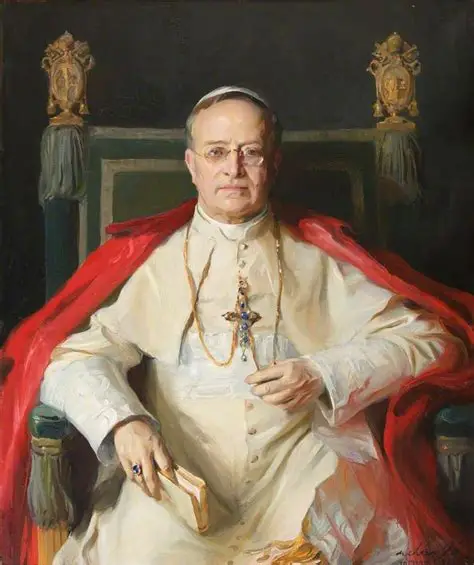
His successor, the Venerable Pope Pius XII (r. 1939–1958), writing at the beginning of the Second World War, again stressed a return to the kingship of Christ.
At the head of the road which leads to the spiritual and moral bankruptcy of the present day stand the nefarious efforts of not a few to dethrone Christ; the abandonment of the law of truth which He proclaimed and of the law of love which is the life breath of His Kingdom. In the recognition of the royal prerogatives of Christ and in the return of individuals and of society to the law of His truth and of His love lies the only way to salvation.8
Pope St. John XXIII (r. 1958–1963) is often credited with setting a new tempo for the relationship between the world and the Church after the wars. Nevertheless, following in his predecessors’ footsteps, he wrote, “[t]he most perniciously typical aspect of the modern era consists in the absurd attempt to reconstruct a solid and fruitful temporal order divorced from God, who is, in fact, the only foundation on which it can endure. In seeking to enhance man’s greatness, men fondly imagine that they can do so by drying up the source from which that greatness springs and from which it is nourished.”9 Despite the warnings of the popes, the majority of Catholic countries rejected the union of Church and state, replacing it with secular liberalism.
When the state rejected the Church, it did not bring a peaceful enlightened utopia, but a community of violent men who strive for peace not out of love, but in order to enjoy worshipping themselves. Without Christ, there is a violent struggle in many nations where warring factions seek to take the throne and use the powers of the state against their opponents. Seeing this, we must make the bold proclamation of Christ as King, the foundation of Catholic Action, Despite the constant teaching of the Church, the necessity of the union between Church and state is nearly unknown by Catholics and is rarely preached by the clergy. Nevertheless, we Catholics today are bound to millennia old teaching taught across the world and reaffirmed by the popes of the past centuries. Thus, in our moral obligation to actively participate in politics, we must also remember our moral obligation to obey the magisterium. That is, in our role in ordering the political body, we must order it to Christ by promoting the union of Church and state. For any man, no matter how noble, cannot wield the powers of the state justly, unless he first submits himself to Christ.
1 Vatican II, Lumen Gentium, § 25. See also, Donum Veritatis § 23
2Pope Gregory XIV, Mirari Vos, § 20.
3 Blessed Pope Pius IX, Syllabus of Errors, § 55. Entire articles could be dedicated to Blessed Pius’ and Leo XIII’s writings on the Church and State, but these will suffice to show their teaching.
4 Pope Leo XIII, Libertas, § 21.
5 Pope St. Pius X, Vehementer Nos.
6 Pope Benedict XV, Ad Beatissimi Apostolorum, § 5.
7 Pope Pius XI, Quas Primas, § 1.
8 Ven. Pope Pius XII, Summi Pontificatus, § 21–22.
9 Pope St. John XXIII, Mater et Magistra, § 217.
Andrew Orozco
Andrew Orozco is a Catholic author, educator, and entrepreneur who holds a Master of Theological Science degree from Franciscan University of Steubenville.