

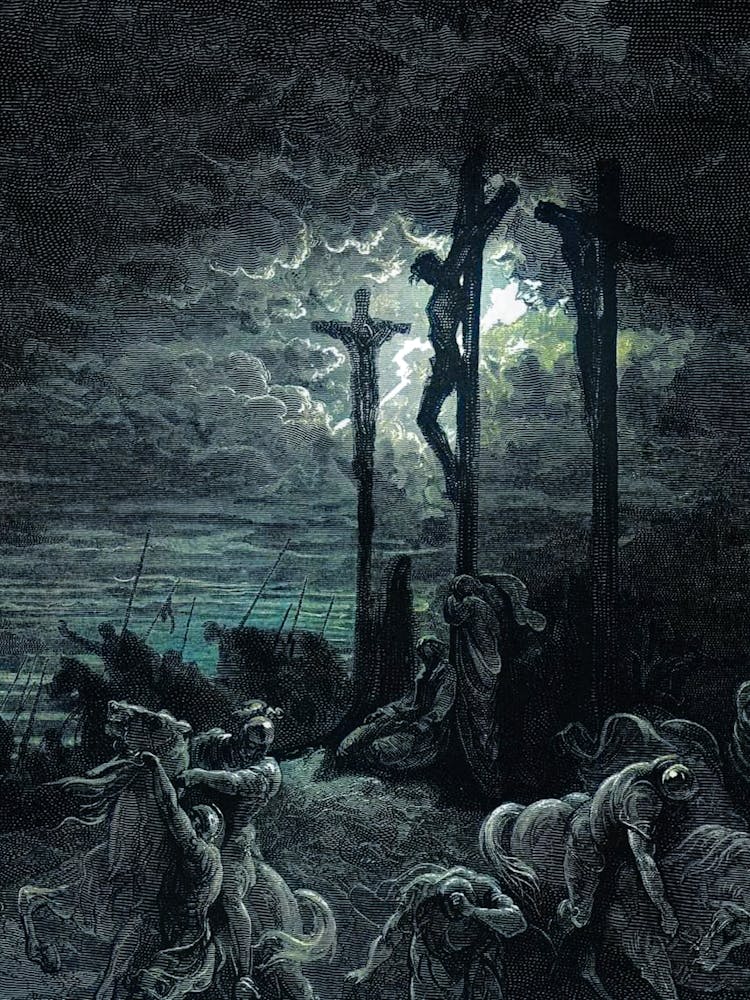
On Christmas Day of last year, my article in Catholic Answers used astronomy software and historical documents to show that Christ was plausibly born on June 17, 2 B.C. In the present article, we will use similar sources and the Gospels to build a solid case for the date of Our Lord’s crucifixion: April 3, A.D. 33. (Interestingly, April 3 rd is also Good Friday this year.) This date is based primarily on the research of Frederick Larson, Timothy Norris and Jimmy Akin.1
Clues from the Gospels and first-century history indicate only two possible dates for Christ’s death: April 7, A.D. 30, or April 3, A.D. 33. This is because all four Gospels describe the crucifixion on Preparation Day (Friday, before the Sabbath) and the day before or during Passover week. Passover begins on Nisan 14/15 (in the spring, according to the Jewish lunar calendar), so Nisan 14 must have fallen on a Friday in the year of Christ’s death. Pontius Pilate served as procurator of Judea from A.D. 26–36, greatly limiting our possible dates. Only A.D. 30 and A.D. 33 align Nisan 14 with Friday during the reign of Pilate.
How can we confidently choose 3 April 33 over 7 April 30? We must first unfold the complex story of Pilate and Tiberius. By the time Tiberius Caesar (42 B.C. – A.D. 37) had reached his mid-sixties, he was weary of ruling the Empire. In A.D. 26 he withdrew into semi-retirement on the island of Capri, where he indulged in a life of unmentionable depravity and cruelty. Meanwhile Tiberius had appointed Aelius Sejanus, formerly captain of the Praetorian Guard, to serve as regent in his absence. Sejanus seemed loyal to Tiberius, but in reality he was deceptive, ambitious and ruthless.
During the five years that Sejanus governed the empire as regent, he methodically arranged the banishment, imprisonment, forced suicide, or other elimination of personal opponents as well as potential successors to Tiberius. As recorded by the Roman senator/historian Tacitus (Publius Cornelius Tacitus, The Annals, Book IV), Sejanus was carefully plotting and murdering his way to the imperial throne. He almost succeeded.
The traitor’s takeover was thwarted by Tiberius’s trusted sister-in-law Antonia, who had delivered a secret message to the emperor. It revealed the full extent of Sejanus’s intricate conspiracy. Tiberius then orchestrated a dramatic reversal, dispatching a letter to be read aloud before the Senate in the plotter’s presence. It delivered a scathing denunciation of Sejanus and demanded his immediate arrest. The stunned schemer was dragged from the Senate and executed on the same day, October 18, A.D. 31. The Senate decreed a damnatio memoriae against him, meaning that his statues were destroyed and his name was erased from all public records.
This date is important because it shows that 33 was a much more likely year than 31 for Christ’s crucifixion. Here’s why. During his period of ascendancy, Sejanus first influenced and then personally directed the appointment of many imperial officials, among them Pontius Pilate. Pilate was installed as Prefect of Judea around the time Tiberius withdrew to Capri. Sejanus was a notorious anti Semite (Philo of Alexandria, Against Flaccus, I), and Pilate faithfully implemented his patron’s persecution of Jews during his governorship of Judea.
Josephus recounts the following incident in Jewish Wars, Book II, Chapter 9:
“Now Pilate, who was sent as procurator into Judea by Tiberius, sent by night those images of Caesar that are called ensigns into Jerusalem. This excited a very great tumult among the Jews when it was day; for those that were near them were astonished at the sight of them, as indications that their laws were trodden under foot; for those laws do not permit any sort of image to be brought into the city…These came zealously to Pilate…and besought him to carry those ensigns out of Jerusalem, and to preserve them their ancient laws inviolable; but upon Pilate’s denial of their request, they fell down prostrate upon the ground, and continued immovable in that posture for five days and as many nights.
On the next day Pilate sat upon his tribunal, in the open market-place, and called to him the multitude, as desirous to give them an answer; and then gave a signal to the soldiers, that they should all by agreement at once encompass the Jews with their weapons; so the band of soldiers stood round about the Jews in three ranks. The Jews were under the utmost consternation at that unexpected sight. Pilate also said to them that they should be cut in pieces, unless they would admit of Caesar’s images, and gave intimation to the soldiers to draw their naked swords.”
Additional anecdotes abound of Pilate’s hateful mistreatment of the Jews. Philo records that Pilate proposed to erect a colossal idol within the Holy of Holies itself. Josephus relates that Pilate diverted funds from religious offerings contributed to the Jewish temple in order to finance Roman construction projects. The Gospel of Luke informs us that Pilate slaughtered Jewish worshippers, mingling their blood with that of their sacrificial offerings—an act of horrific desecration (Luke 13:1). At the crucifixion of Jesus, Pilate affixed to the cross a placard declaring him “The King of the Jews,” thereby deriding the Jewish leadership even while acceding to their demands.
These episodes raise a major question concerning the execution of Jesus. Pilate’s established pattern had been to vex his Jewish subjects. Why, then, did he ultimately yield to the clamor of the Jewish leaders calling for Jesus’s death? Why did he not simply release Jesus, if only to spite the priests who demanded his execution? The Gospels indicate that Pilate initially intended to release Jesus. Something, however, had altered the political calculus. Something now compelled Pilate to respond, albeit reluctantly, to the demands of the Jews rather than treat them with his customary contempt.
That something was Sejanus. Following the traitor’s dramatic execution in A.D. 31, Tiberius initiated a systematic purge of Sejanus’s appointees and associates. Many were subjected to protracted trials, torture, and executions deliberately calculated to inspire maximum terror. In De Vita Caesarum: Tiberius, Suetonius describes such tortures in terms too gruesome to mention here. One of the comparatively milder passages (LXII) states:
“At Capri they still point out the scene of his executions, from which he used to order that those who had been condemned after long and exquisite tortures be cast headlong into the sea before his eyes, while a band of marines waited below for the bodies and broke their bones with boathooks and oars, to prevent any breath of life from remaining in them.”
Tacitus, in The Annals, Book V, records the terror of the purge:
“Executions were now a stimulus to [Tiberius’] fury, and he ordered the death of all who were lying in prison under accusation of complicity with Sejanus. There lay, singly or in heaps, the unnumbered dead, of every age and sex, the illustrious with the obscure…The force of terror had utterly extinguished the sense of human fellowship, and, with the growth of cruelty, pity was thrust aside.”
Tiberius also countermanded many of Sejanus’s directives and policies, including his anti Semitic measures. The new imperial directive was effectively to leave the Jews in peace and “to comfort them” (as described by Philo of Alexandria, On the Embassy to Gaius, XXIV). This reversal was part of a brutal campaign to eliminate officials installed by Sejanus—such as Pilate.
After A.D. 31, therefore, Pilate operated in fear for his career and life. If the trial of Jesus occurred subsequent to this date, Pilate’s uncharacteristic ambivalence toward Jesus and the Jewish leadership suddenly makes sense. Any public display of his former anti-Semitic prejudices could have proven fatal. In this light, we can appreciate why Pilate was alarmed by the insistent shouts of the crowd: “From then on, Pilate tried to set Jesus free, but the Jews kept shouting, ‘If you let this man go, you are no friend of Caesar; everyone who makes himself a king sets himself against Caesar.’” (John 19:12)
Pilate’s reluctant compliance with the demands of the Jewish leaders thus emerges as a calculated act of self preservation. This is also why April 3, 33 is a much more likely date for the first Good Friday than April 7, 30.
Additional Clues
The Gospels report darkness from noon to 3 P.M. on the day Christ died. This is also corroborated by secular sources such as Phlegon Trallianus, who records in his Olympiades:
“In the fourth year of the 202nd Olympiad, [A.D. 32-33] a failure of the Sun took place greater than any previously known, and night came on at the sixth hour of the day [noon], so that stars actually appeared in the sky; and a great earthquake took place in Bithynia and overthrew the greater part of Nicaea.”
Julius Africanus mentions this as well: “Phlegon records that, in the time of Tiberius Caesar, at full moon, there was a full darkening of the sun from the sixth hour to the ninth–manifestly that one of which we speak. On the whole world there pressed a most fearful darkness; and the rocks were rent by an earthquake, and many places in Judea and other districts were thrown down.” (Julius Africanus, Chronology, 18.1)
Another Christian historian, Origen, also cites Phlegon: “And with regard to the eclipse in the time of Tiberius Caesar, in whose reign Jesus appears to have been crucified, and the great earthquakes which then took place, Phlegon too, I think, has written in the thirteenth or fourteenth book of his Chronicles.; (Origen, Against Celsus (Edinburgh: T. and T. Clark, 1872), Book II, Chapter XXXIII)
Phlegon, Julius and Origen apparently agree that an earthquake shook the region in A.D. 33, not 30.
Peter at Pentecost (in Acts 2) quotes Joel 2: “The sun will be turned to darkness and the moon to blood before the coming of the great and glorious day of the Lord. And everyone who calls on the name of the Lord will be saved.”
Peter then says, “Men of Israel, listen to this: Jesus of Nazareth was a man accredited by God to you by miracles, wonders and signs, which God did among you through him, as you yourselves know.”
In other words, Joel’s prophecy had been fulfilled because everyone had recently witnessed hours of daytime darkness and a blood moon on Good Friday. A blood moon; means a lunar eclipse, because the moon reddens in Earth’s shadow due to sunlight having scattered and refracted through Earth’s atmosphere. (This happened recently on March 3, 2026.) Only one Passover lunar eclipse was visible from Jerusalem during Pilate’s tenure: a partial eclipse on April 3, A.D. 33. Modern astronomy software such as CyberSky (https://cybersky.en.softonic.com) and Starry Night 8 (https://starrynight.com) verify that the moon indeed rose that night at about 6:20 P.M., already eclipsed. The rising blood moon was at the feet of the constellation Virgo.
In the Catholic Answers article mentioned earlier, we saw that just after sunset on 11 Sept. 3 B.C. (Christ’s conception in Mary’s womb), the constellation that rose in the east behind Leo was Virgo, literally “clothed with the Sun, with the moon under her feet, and on her head a crown of twelve stars.” (Rev. 12:1) It was a new moon at Mary’s feet, coinciding with the Jewish New Year (Rosh Hashanah). Now, at Passover on 3 April 33, the rising blood moon indicated a life extinguished, a Paschal Lamb sacrificed for the world’s redemption. The constellation Virgo represented the Mother who now held her dead Son taken down from the cross.
Conclusion
While April 3, A.D. 33 is the most likely date for Christ’s crucifixion, what matters most is that Jesus lived, died and rose again out of extravagant love for us sinners. This Good Friday (3 April 2026), let us accompany our Redeemer at each step of the Via Dolorosa, consoling him with our contemplation and offering up our sufferings in union with His.
1 The main works cited in this article are Frederick Larson’s excellent website https://bethlehemstar.com, Timothy Norris’
book The Star of Bethlehem (https://a.co/d/6kaOiNC), and Jimmy Akin’s website https://jimmyakin.com.