

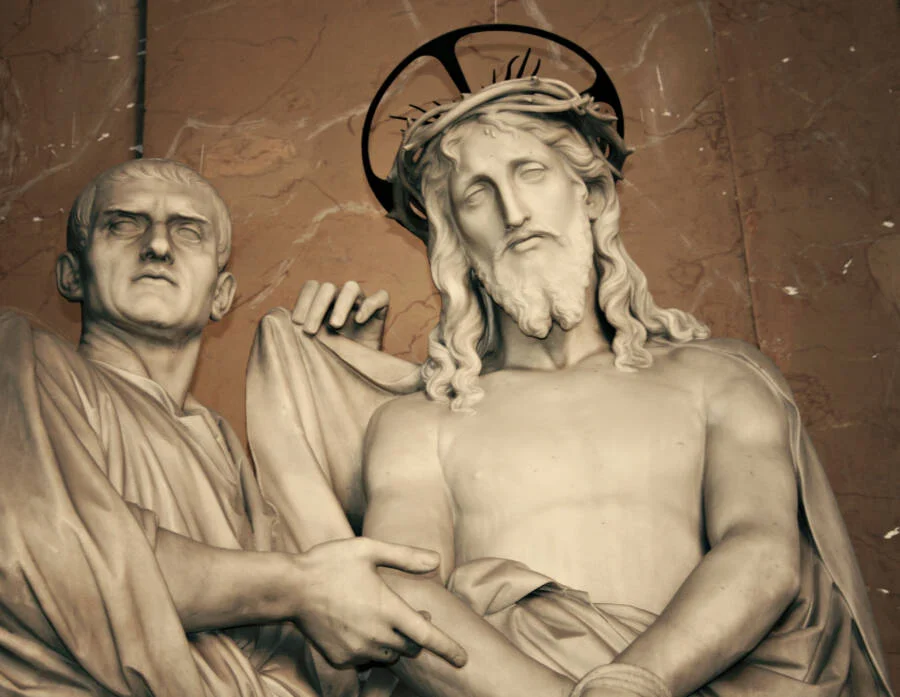
It is often the case, that when Christians attempt to advocate for Christianity or Christian morals in politics we are told that Christ is unpolitical. The secularists argue that Christians wanting their country to be Christian, is really a lust for power that would be condemned by our Lord. The Liberals lecture us, stating that Christ was meek, and He would not want His teachings to impact our political lives. After all, didn’t Jesus say, “My kingship is not of this world”? Yet this line of argumentation shows a lack of understanding of politics, of who Jesus Christ is, and a misunderstanding of our Lord’s kingship.
What is Politics?
Politics is a branch of ethics that examines how communities can all achieve their ends. Ethics tells us that our ultimate end as humans is the worship of God, the highest good. Thus, politics, by its nature, concerns how a society can guide all men to the love of God. Of course, men also have material needs, and hence politics is concerned with economics, military, domestic, and other subordinate sciences.
However, many reduce politics to games of power, boiling civil life to semi-annual competitions where men and women bought out by corporations vie for the quasi-all-powerful throne of the federal government. Once in power, the losers bite their nails hoping that their enemies cannot strip away whatever object they are attached to, whether it be the right order of things, such as family and economic sufficiency, or disordered sins paraded as liberty.
This may be the reality of politics in our empire, but it is a corroded picture that neglects what politics is all about: God. Since Christianity is the one true religion and the Trinity is the only God, our Lord Jesus is deeply concerned about our political well-being.
Thus, Christians who seek to re-order the political game back to Christ do not do so out of lust for power, but out of a desire to correct the course. Rather, those who seek to keep politics obscured and away from God, like games in a colosseum, are lusting for power, so they may make the end of politics their own enrichment as opposed to the glory of God and the common good.
Who is the Christ?
Often, people think that Christ is Jesus’s last name. This is not the case. Christ comes from the Greek Christos, a translation of the Hebrew Mashiach, meaning anointed one. This term came to describe the promised savior of the Jewish people. This savior would be like a new Moses, bringing a new law and covenant, but also a new David, bringing the restoration of God’s promised kingdom.
In 2 Samuel God said to David,
12 When your days are fulfilled and you lie down with your fathers, I will raise up your offspring after you, who shall come forth from your body, and I will establish his kingdom. 13 He shall build a house for my name, and I will establish the throne of his kingdom for ever. 14 I will be his father, and he shall be my son. When he commits iniquity, I will chasten him with the rod of men, with the stripes of the sons of men; 15 but I will not take my steadfast love from him, as I took it from Saul, whom I put away from before you. 16 And your house and your kingdom shall be made sure for ever before me; your throne shall be established for ever.’”
The Jews were waiting for a descendant of King David, who would rule the fulfilled and perfect kingdom of David. Thus, the Christ, will be a king.
The prophet Daniel also tells us about the timing of this king’s arrival. Emperor Nebuchadnezzar II of Babylon had a dream about a great statue composed of different types of metal. Yet, this mighty statue was destroyed by a small stone. Horrified, he asked the prophet Daniel to interpret the dream, and he said
36 “This was the dream; now we will tell the king its interpretation. 37 You, O king, the king of kings, to whom the God of heaven has given the kingdom, the power, and the might, and the glory, 38 and into whose hand he has given, wherever they dwell, the sons of men, the beasts of the field, and the birds of the air, making you rule over them all—you are the head of gold. 39 After you shall arise another kingdom inferior to you, and yet a third kingdom of bronze, which shall rule over all the earth. 40 And there shall be a fourth kingdom, strong as iron, because iron breaks to pieces and shatters all things; and like iron which crushes, it shall break and crush all these. 41 And as you saw the feet and toes partly of potter’s clay and partly of iron, it shall be a divided kingdom; but some of the firmness of iron shall be in it, just as you saw iron mixed with the miry clay. 42 And as the toes of the feet were partly iron and partly clay, so the kingdom shall be partly strong and partly brittle. 43 As you saw the iron mixed with miry clay, so they will mix with one another in marriage, but they will not hold together, just as iron does not mix with clay. 44 And in the days of those kings the God of heaven will set up a kingdom which shall never be destroyed, nor shall its sovereignty be left to another people. It shall break in pieces all these kingdoms and bring them to an end, and it shall stand for ever; 45 just as you saw that a stone was cut from a mountain by no human hand, and that it broke in pieces the iron, the bronze, the clay, the silver, and the gold. A great God has made known to the king what shall be hereafter. The dream is certain, and its interpretation sure.”
Thus, the kingdom that the Christ will bring, will be a worldwide and divine kingdom that will end the rule of the pagan nations. Traditionally, these four kingdoms had been interpreted to refer to Babylon, Medo-Persia, Greece, and Rome. Therefore, Jews in the time of the Roman Empire anticipated that Christ would in some way overthrow Rome and inaugurate the kingdom.
These Jews were not wrong to believe that the Messiah would have a political role. However, it is wrong to say that Christ is primarily a political ruler. Our Lord would indeed conquer the nations, but not by rolling the political dice of fallen men.
Not of this World
We now arrive at the climax of our Lord’s life, His passion. The Jews handed Him over to the Romans because our Lord, as Christ, is a king. The Jews wanted Christ’s kingship to clash with Rome’s political hegemony, and thus for Rome to kill Him as a rebel. Our Lord then spoke with Pontius Pilate, the Roman governor.
33 Pilate entered the praetorium again and called Jesus, and said to him, “Are you the King of the Jews?” 34 Jesus answered, “Do you say this of your own accord, or did others say it to you about me?” 35 Pilate answered, “Am I a Jew? Your own nation and the chief priests have handed you over to me; what have you done?” 36 Jesus answered, “My kingship is not of this world; if my kingship were of this world, my servants would fight, that I might not be handed over to the Jews; but my kingship is not from the world.” 37 Pilate said to him, “So you are a king?” Jesus answered, “You say that I am a king. For this I was born, and for this I have come into the world, to bear witness to the truth. Every one who is of the truth hears my voice.”
Pilate is interested in seeing whether or not Jesus, as king, is planning on overthrowing the Roman Empire. Here, Jesus notes that He is a king, but He is not a king in the way Pilate fears. Christ did not come to overthrow Rome. He didn’t come to establish a physical political kingdom on the map, with borders, a census, taxation, a military, and all other pomp and glory that the nations have. Jesus is a different kind of king.
Does this mean that Jesus intends His message to be secret and private, with no effect on politics? No. What this means is that Jesus did not come to overthrow empires by a military takeover.
Christ begins spiritually, by the annulment of sin and the conquest of demons. He seeks to be an exorcist who expels the demons that have conquered souls that rightfully belong to Him.1 In the Biblical Worldview, God is at the top, and then God has a Divine Council that governs the world with Him. Below this spiritual world, humanity lives on the earth, to reflect God visibly. Due to sin, some of these members of the Divine Council fell and became demons, and due to human sin, demons rule nations.
In His plan to restore creation, Our Lord first expels demons and changes men’s hearts. He does not come with a sword to slaughter, but with a cross, to be an exorcist. He wants to free the nations and bring them to obedience, not replace them. Our Lord later tells the Apostles
18 And Jesus came and said to them, “All authority in heaven and on earth has been given to me. 19 Go therefore and make disciples of all nations, baptizing them in the name of the Father and of the Son and of the Holy Spirit, 20 teaching them to observe all that I have commanded you; and lo, I am with you always, to the close of the age.”
Our Lord clearly has political and worldwide ambitions here, but not like Alexander, Caesar, Buckingham Palace, the Kremlin, or the White House. Since our Lord has all authority on earth, He therefore has authority over all the nations and the governments of the earth. Yet, he doesn’t use this power to obliterate and replace them. He uses this power to send His Apostles out, to exorcise them. Through their preaching and teaching, these nations will observe what Christ commanded. Everything that Christ taught will be instilled in these nations, and they will change politically without losing their identity or resorting to bloodshed.
Even though Christ didn’t march an army on Rome, He would eventually conquer Rome spiritually. The Apostles would spread the Gospel, and after centuries of persecution, the Roman Empire itself would convert. Rome wasn’t replaced, but changed. The old gods of violence, greed, and vainglory were cast out.
In the West, Rome would fall in 476, but in its ashes, many Christian kingdoms inspired by Rome would arise, and these nations accepted Christ as king, and united Christ and politics for over a millennium. In the East, the Roman Emperors would rule from the city of Constantinople, as Christians, until 1453.
Christ is king of the entire world, and this has political implications. The nations must convert. This, however, doesn’t have military implications. Christ will not force anyone to believe in Him at the point of a sword, but by pouring out His Spirit on the nations, causing them to confess Him publicly and privately as Lord.
Obedience to Christ
Thus, Jesus, as God and Christ, wants every nation on earth to be obedient to Him. When He came in the flesh. He came in humility to reveal the glory of God and to save men. This first coming in humility does not mean our Lord was an anarchist or an Enlightenment liberal. Yet, His role in politics also does not mean that He is a mascot for the American right, a stamp of approval that so-called Conservatives can slap on the side of a missile. Our Lord does not fit into the Left or the Right of American politics; He calls both ends to be obedient to Him.
Thus, as Christians, we must boldly praise the name of Christ in our Churches and our courts. Our country needs an exorcism! However, this doesn’t mean merely slapping a crucifix on a flag, but a turning over of institutions of sin, which will upset the Left and Right. Christ, and Christianity as His mystical body, is essentially political, but not in the sense of arms and blood, but in the sense of divinization.
1 Andrew Orozco, America Needs an Exorcism